Manta rays and whale sharks in the Maldives: where and when to see them
The best places and seasons to swim with mantas and whale sharks: Hanifaru Bay, Lankan Manta Point, South Ari, how the monsoons move the plankton, the rules and responsible encounters.
Quick answer
- The Maldives has the largest known population of reef manta rays, present all year but moving with the monsoons.
- Hanifaru Bay in Baa Atoll is snorkel-only and permit-controlled, with the biggest gatherings usually July to October.
- Whale sharks are seen year-round in the South Ari Marine Protected Area, declared in 2009.
- Keep your distance, never touch, and go with licensed operators who follow the rules.
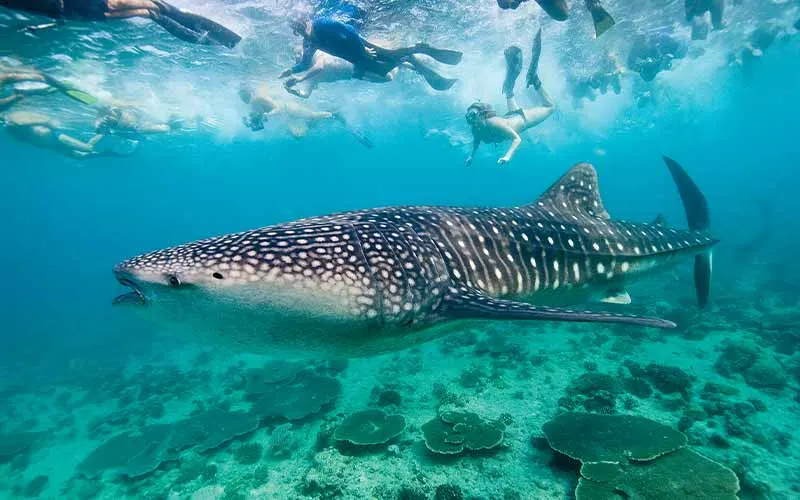
Swimming alongside a manta ray or a whale shark is, for many visitors, the highlight of a Maldives trip. The country is one of the best places in the world for both. Research describes the Maldives as home to the largest known population of reef manta rays, and whale sharks are seen year-round in South Ari Atoll. This guide explains where and when to go, how the monsoons affect your chances, and how to have a responsible encounter.
Manta rays
Present all year, moving with the monsoons
Reef manta rays live in the Maldives throughout the year, but they move around the atolls following the plankton they feed on. Research from the University of Plymouth links their seasonal movements to the South Asian monsoon, which drives ocean currents and plankton blooms. In simple terms, mantas follow the food "downwind" of the monsoon, so the best sites change between the northeast and southwest monsoons. Your dive operator will know where they're being seen this season.
Hanifaru Bay (Baa Atoll)
Hanifaru Bay is the Maldives' most famous manta site, part of the Baa Atoll UNESCO Biosphere Reserve. During the southwest monsoon, plankton collects in the shallow bay and can draw large feeding aggregations of mantas, sometimes alongside whale sharks.
- Season: sources give roughly May or June to November, with the largest gatherings typically July to October. Sightings depend on conditions, so they're never guaranteed.
- Snorkel only: diving isn't allowed in the bay.
- Permits and guides: visits require a permit, arranged through licensed operators or resorts, and groups are accompanied by certified guides. Visitor fees have supported the Baa Atoll conservation fund.
- Limits: numbers of boats and visitors in the bay at one time are capped; published figures differ, so follow your operator's briefing.
- Rules: no touching or feeding, no underwater lights, and flash photography restricted.
The nearest base is Baa Atoll, by resort or by guesthouse on a nearby local island; Dharavandhoo has a domestic airport. See our guide to domestic flights.
Lankan Manta Point (North Malé Atoll)
Close to Malé, Lankan Manta Point near Lankanfinolhu is a popular cleaning station, where mantas visit to be cleaned by small fish. Sources differ on the best months, with several pointing to roughly mid-year through November. Currents can be strong, so divers should be comfortable with drift diving. Its closeness to Malé makes it accessible from many resorts and guesthouse islands.
Other manta sites
Many atolls have manta cleaning stations and feeding spots, including in Ari Atoll, Raa, Lhaviyani and Addu. Liveaboard trips often move between sites to follow the season. Ask local dive centres where mantas have been seen recently.
Whale sharks
South Ari Marine Protected Area
Whale sharks, the world's largest fish, are seen throughout the year along the southern rim of South Ari Atoll. The South Ari Marine Protected Area (SAMPA), declared in 2009, runs about 14 km from Maamigili in the west to Dhigurah in the east. The whale sharks here are mostly juveniles, and sightings are reported in all seasons.
- How to see them: boat trips from islands and resorts in South Ari, often in the morning, searching the outer reef.
- Snorkelling works: whale sharks often cruise near the surface along the reef at shallow depths, so you don't need to dive.
- Bases: guesthouse islands such as Dhigurah and Maamigili (which has a domestic airport), and resorts in South Ari.
- Conditions: the dry season usually brings better visibility; the wet season brings plankton that can concentrate feeding.
Some sources claim South Ari is one of very few places in the world with year-round whale sharks; treat "the only place" claims as marketing, but it's certainly one of the most reliable.
Other whale shark encounters
Whale sharks are sometimes seen elsewhere, including in Baa Atoll during the manta season, and around other atolls. Encounters outside South Ari are less predictable.
How to have a responsible encounter
- Choose licensed, responsible operators who brief you on the rules and limit group sizes.
- Keep your distance: guides commonly recommend at least 3–4 metres from whale sharks, and more from the tail.
- Never touch, chase or ride the animals.
- Don't block their path or surround them.
- No flash photography, especially at Hanifaru Bay.
- Enter the water calmly, without splashing, when the guide says so.
- Use reef-safe sunscreen or cover up with a rash guard.
- Don't stand on coral or touch the reef.
Snorkelling or diving?
Both mantas and whale sharks can be seen by snorkellers, which is good news for non-divers. Hanifaru Bay is snorkel-only. For manta cleaning stations, diving gives longer encounters. If you're a confident swimmer but not a diver, ask for snorkel-focused trips; if you're new to snorkelling, practise first and wear a buoyancy vest.
Planning tips
- Match your dates: plan around July to October if Hanifaru Bay is your priority.
- Stay nearby: base yourself in Baa for Hanifaru, and South Ari for whale sharks.
- Allow several days: wildlife isn't guaranteed, so give yourself more than one chance.
- Check recent sightings with local operators before booking.
- Bring an underwater camera, without flash.
- Get insurance that covers snorkelling and diving.
What to bring on the trip
- a well-fitting mask and snorkel, and fins if you have them;
- a rash guard or wetsuit top for sun protection;
- reef-safe sunscreen, applied well before entering the water;
- a buoyancy vest if you're not a strong swimmer;
- an underwater camera or waterproof phone case, with flash off;
- water, a hat and seasickness tablets for the boat; and
- a towel and a dry layer for the ride back.
Questions to ask an operator
- Where have mantas or whale sharks been seen in the last few days?
- How many people will be on the boat and in the water at once?
- Do you follow the local rules on distance and group size, and will we get a briefing?
- What happens if we don't see anything; is there a discount or a second chance?
- Is the trip suitable for children or weaker swimmers?
Photography tips
Turn off the flash, stay still and let the animal come past rather than chasing it, and shoot slightly upwards towards the surface light for the best silhouettes. Wide-angle settings work best for large animals. Above all, enjoy the moment: some of the best encounters are the ones you simply watch.
Seasons at a glance
| What | Where | When |
|---|---|---|
| Manta feeding aggregations | Hanifaru Bay, Baa | About May/June–November; peak July–October |
| Manta cleaning stations | Lankan Manta Point and others | Year-round; best months vary by site |
| Whale sharks | South Ari MPA | Year-round |
See our guide to the best time to visit for weather by month.
Weather and cancellations
Trips depend on sea conditions, especially in the southwest monsoon. Operators may cancel or change plans for safety, and visibility can vary. Build flexibility into your schedule, ideally with more than one day available for your main wildlife trip.
Conservation
Mantas and whale sharks bring significant tourism income to the Maldives, which gives communities a strong reason to protect them. You can help by choosing responsible operators, following the rules, and, if you take photos of mantas, sharing them with research projects that identify individual animals by their markings.
Common questions
When is the best time to see manta rays in the Maldives?
Mantas are present all year. For the big feeding gatherings at Hanifaru Bay, the season runs roughly from May or June to November, with the largest gatherings typically from July to October.
Can you dive at Hanifaru Bay?
No. Hanifaru Bay is snorkel-only. Diving isn't allowed, to protect the feeding mantas in the shallow bay.
Where can I swim with whale sharks?
The South Ari Marine Protected Area in Alif Dhaal Atoll, between Maamigili and Dhigurah, is the best-known place, with whale sharks seen throughout the year.
How close can I get to a whale shark?
Guides commonly recommend keeping at least 3 to 4 metres away, never touching, and not blocking the animal's path. Follow your guide's briefing and local rules.
Are manta rays dangerous?
No. Manta rays are filter feeders with no stinging barb, and they're gentle. The main rules are about protecting them: keep your distance and never touch.
Official sources
- CMS: Elasmobranch tourism factsheet, Hanifaru Bay
- University of Plymouth: Seasonal distribution of reef manta rays in the Maldives
- PADI: Hanifaru Bay dive site
- PADI: Maamigili Beyru dive site
Last reviewed 18 November 2026. This guide is general information, not legal or financial advice. Rules change, so confirm with the official source before you apply. Report an error
Manta raysWhale sharksSnorkelling
Related guides
From our network
Maldives Investments
Apartments, houses and land for sale and rent in Malé, Hulhumalé and across the Maldives, with prices.
Browse property listings ↗maldivesinvestments.com is run by the same team as HandyMaldives.