The Maldives green tax explained: rates, exemptions and how it's charged
What the green tax is, the USD 12 and USD 6 nightly rates since January 2025, who is exempt, how it appears on your bill, and what accommodation providers must do.
Quick answer
- The green tax is a fixed charge per tourist per night of accommodation, collected by the accommodation provider.
- From 1 January 2025: USD 12 per person per night at resorts, hotels, tourist vessels and larger guesthouses.
- USD 6 per person per night at hotels and guesthouses with 50 or fewer rooms on inhabited islands.
- Children under two, Maldivians and resident permit holders are exempt.
If you have booked a holiday in the Maldives, you have probably noticed a line on your bill called "green tax". It is one of several taxes and charges on tourism, and it doubled at the start of 2025, so older articles and blog posts often quote out-of-date figures. This guide explains the current rates, who pays and who is exempt, how the tax is calculated, and what accommodation providers must do.
What is the green tax?
The green tax is a fixed charge on tourists for each night they stay in tourist accommodation in the Maldives. It is collected by the accommodation provider (the resort, hotel, guesthouse or tourist vessel) and paid to the Maldives Inland Revenue Authority (MIRA). Revenue from the tax is intended to support environmental projects, which matter enormously in a low-lying island nation facing rising seas, waste management challenges and pressure on fragile reefs.
Unlike GST, which is a percentage of the price, the green tax is a flat amount per person per night, regardless of how much the room costs.
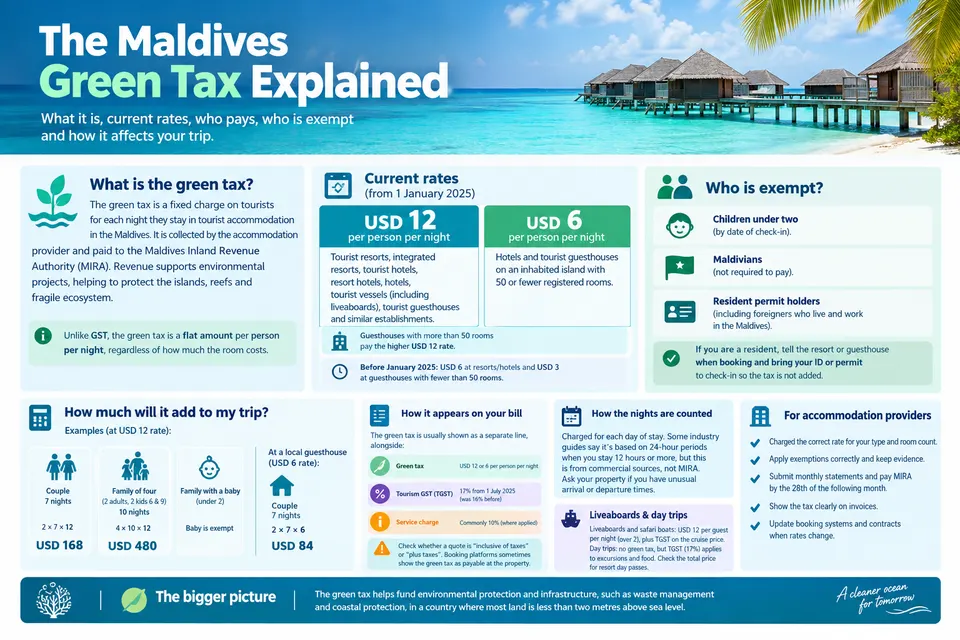
Current rates (from 1 January 2025)
Under MIRA's circular on the rate changes effective 1 January 2025:
USD 12 per person per night for tourist resorts, integrated tourist resorts, tourist hotels, resort hotels, hotels, tourist vessels (including liveaboards), tourist guesthouses and similar establishments.
USD 6 per person per night for hotels and tourist guesthouses operating on an inhabited island with 50 or fewer registered rooms.
Guesthouses with more than 50 rooms pay the higher USD 12 rate.
What the rates were before
Before January 2025, the green tax was USD 6 per night at resorts and hotels, and USD 3 at guesthouses with fewer than 50 rooms. If you see these figures, the source is out of date.
Who is exempt?
Children under two: children who have not reached two years of age by the date of check-in are exempt.
Maldivians are not required to pay the green tax.
Resident permit holders, including foreigners who live and work in the Maldives, are also exempt.
If you live in the Maldives and are taking a staycation, tell the resort or guesthouse when booking and bring your ID or permit to check-in so the tax is not added.
How much will it add to my trip?
Because it is charged per person per night, the green tax adds up for families and longer stays. Some examples at the USD 12 rate:
Couple, 7 nights: 2 × 7 × USD 12 = USD 168
Family of four (two adults, two children aged 6 and 9), 10 nights: 4 × 10 × USD 12 = USD 480
Family with a baby under two: the baby is exempt
At a small guesthouse on a local island charging USD 6, the same couple would pay USD 84 for seven nights.
How the green tax appears on your bill
Resorts and guesthouses usually show the green tax as a separate line, alongside:
Tourism GST (TGST) at 17% from 1 July 2025 (it was 16% before); and
a service charge, commonly 10%, where the establishment applies one.
When comparing prices, check whether a quote is "inclusive of taxes" or "plus taxes". A room advertised at a low headline price can cost considerably more once green tax, TGST and service charge are added. Booking platforms sometimes show the green tax as payable at the property.
How the nights are counted
Green tax is charged for each day of stay. Some industry guides describe it being charged per 24-hour period when a guest stays 12 hours or more in that period, but this description comes from commercial sources rather than MIRA itself. If you have an unusual arrival or departure time, ask the property how they will charge it.
Green tax versus TGST: the difference
Green taxTourism GST (TGST)TypeFixed amount per person per nightPercentage of the priceRateUSD 12 or USD 617% from 1 July 2025Applies toNights in tourist accommodationTourism goods and services, including rooms, food, excursionsExemptUnder-2s, Maldivians, resident permit holdersSet by the GST Act
See our guide to GST and TGST for more on the percentage tax.
For accommodation providers
If you run a resort, hotel, guesthouse or tourist vessel, you are responsible for collecting and paying the green tax:
Charge the correct rate for your type of establishment and room count. Small guesthouses near the 50-room line should be clear which rate applies.
Apply exemptions correctly and keep evidence, such as passport copies showing children's dates of birth and copies of resident permits.
Submit monthly statements and pay MIRA by the 28th of the following month.
Show the tax clearly on invoices so guests understand the charge.
Update booking systems and contracts with tour operators when rates change, including for bookings made before a change.
Airport transit hotels and stopovers
Many travellers spend a night in Hulhumalé or Malé before or after a resort stay, or on a stopover. These hotels are tourist accommodation too, so the green tax applies. Hulhumalé and Malé are inhabited islands, so a hotel or guesthouse there with 50 or fewer registered rooms charges the lower USD 6 rate, while larger hotels charge USD 12. If you are comparing transit hotels, it is worth checking which rate each one applies.
Day trips and excursions
The green tax is charged on days of stay in accommodation. A day trip, such as a picnic island excursion or a visit to a resort for a meal, does not by itself involve a night's accommodation, but tourism GST at 17% applies to the excursion and food. Resorts selling day passes include their own taxes and charges, so check the total price.
Liveaboards and safari boats
Tourist vessels, including liveaboard dive boats and safari cruises, are in the USD 12 category. On a week-long liveaboard trip, each guest over two pays USD 12 for every night on board, in addition to TGST on the cruise price.
Why the increase?
The government doubled the green tax as part of wider measures affecting the tourism sector, alongside the increase in TGST. Industry groups, particularly representing guesthouses, raised concerns that higher charges could make the Maldives less competitive, especially for budget travellers who choose local islands. The government's position is that tourism should contribute more to the environmental and infrastructure costs it creates.
What the money is for
The green tax was introduced to fund environmental protection and infrastructure, such as waste management and coastal protection, in a country where most land is less than two metres above sea level. Travellers who want to reduce their own impact can also choose operators that manage waste responsibly, avoid single-use plastics, follow reef-safe practices when snorkelling and diving, and support local businesses on inhabited islands.
Planning tips for travellers
Ask for quotes that include all taxes and charges so you can compare properly.
Remember that every person over two pays, per night.
If you split your stay between a guesthouse and a resort, the rate can differ for each part.
Keep your invoice: it should show the green tax separately.
Check before you book
The figures in this guide reflect MIRA's January 2025 circular and later reporting. We found no change after that at the time of writing, but tourism taxes can change with new legislation. Check MIRA's website or ask your accommodation provider for the current rate when you book.
Common questions
How much is the green tax in the Maldives?
From 1 January 2025, it is USD 12 per person per night at resorts, hotels, tourist vessels and guesthouses with more than 50 rooms, and USD 6 per person per night at hotels and guesthouses on inhabited islands with 50 or fewer rooms.
Do children pay green tax?
Children who have not reached two years of age by the date of check-in are exempt. Older children pay the same rate as adults.
Do expats living in the Maldives pay green tax when they stay at a resort?
Maldivians and holders of resident permits are not required to pay green tax. Bring proof of your status when checking in.
Is green tax included in the room price?
Often it is shown separately on quotes and invoices. Check whether a price includes taxes, because the green tax, TGST at 17% and any service charge can add significantly to the total.
Official sources
- MIRA: Circular on changes to green tax rates from 1 January 2025
- Raajje.mv: Green tax doubled from January 2025
- MIRA: Goods and Services Tax
Last reviewed 13 October 2026. This guide is general information, not legal or financial advice. Rules change, so confirm with the official source before you apply. Report an error