Maldives public ferries: how to use the RTL network to travel between islands
How the public ferry network works, where to find current timetables, buying tickets, Friday services, luggage, and tips for travelling between local islands on a budget.
Quick answer
- Public ferries connect Malé with inhabited islands and are by far the cheapest way to travel.
- Current schedules are published by Raajje Transport Link (RTL) on its website and app.
- Many ferry routes don't run every day, and most do not run on Fridays, so plan around the timetable.
- Ferries are slow compared with speedboats, so allow plenty of time and check the weather.
Speedboats and seaplanes get most of the attention, but the Maldives also has a network of public ferries that connect Malé with inhabited islands across the central atolls. They are what Maldivians use to visit family, go to work and move goods, and they are the cheapest way for visitors and residents to travel between islands. They are also slow and run on limited schedules, so a little planning goes a long way. This guide explains how the network works and how to use it.
Who runs the ferries?
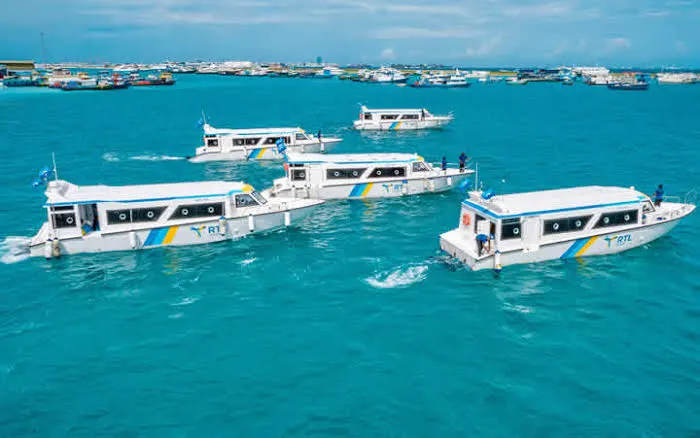
Public transport in and around Malé, and many inter-island ferry routes, are operated under Raajje Transport Link (RTL), the national public transport network, with services operated by the Maldives Transport and Contracting Company (MTCC) and others. RTL publishes schedules, ticketing and route information on its website and app. Some atolls also have local ferry services within the atoll.
Finding the current timetable
Ferry timetables change, and the schedules copied onto travel blogs quickly become out of date. Use the official source:
- RTL website: the schedule section at rtl.mv lists routes and departure times.
- RTL app: shows schedules and offers ticketing on supported routes.
- Your guesthouse: guesthouses on local islands know the ferry times to and from their island and can confirm whether a service is running.
When planning, check four things: the days the route runs, the departure time, the departure terminal in Malé, and the journey time.
Ferry terminals in Malé
Malé has several ferry terminals serving different destinations, including the airport ferry terminal, the Villingili ferry terminal on the southwest side of the city for the short hop to Villimalé, and terminals for longer inter-island routes. Travel guides disagree on which terminal some routes use, because terminals have changed over the years. Always confirm the departure terminal for your route on RTL or with your guesthouse before you go, and allow time to find it: Malé is small, but its waterfront is busy.
Days of operation and Fridays
Friday is the weekly holiday in the Maldives. Most inter-island public ferry routes do not run on Fridays, while the airport ferry does. Many longer routes only run on certain days of the week, sometimes just two or three times. If you are staying on a local island, check that the ferry runs on the day you need to get back to the airport, and build in a buffer day before an international flight.
Tickets and fares
Public ferry fares are low. Short routes cost a small amount in rufiyaa, and even routes from Malé to islands in neighbouring atolls typically cost only a few US dollars, far less than a speedboat. Fares vary by route and are updated from time to time, so check the current fare on RTL.
RTL offers online and app ticketing for many services, with options for single trips and multiple journeys. On some routes, tickets are still bought at the terminal or on board. Keep some rufiyaa in small notes in case cash is needed.
What the journey is like
Public ferries are practical boats, not tourist cruisers. Expect:
- Slow journeys: often an hour or more for routes to nearby atolls, and several hours for longer routes.
- Basic seating, sometimes inside a cabin and sometimes on open benches.
- Shared space with cargo, as ferries carry goods to the islands.
- Local passengers, including families and workers. Dress modestly, covering shoulders and knees, as you would on a local island.
- Sun and spray: bring sunscreen, a hat and water.
Luggage
Ferries generally carry passengers' luggage, including suitcases, but space is limited and bags may be stacked together or placed near cargo. Use a sturdy bag, keep valuables, documents and electronics with you in a waterproof bag, and label your luggage.
Weather and sea conditions
Sea conditions vary with the season. The southwest monsoon, roughly May to October, brings more wind, rain and rougher seas; the northeast monsoon, roughly December to April, is usually calmer and drier. Ferries can be delayed or cancelled when conditions are bad. If you are prone to seasickness, take medication before departure and sit near the middle of the boat, low down if possible.
Ferries for residents and commuters
Within the Greater Malé area, frequent ferries link Malé with Villimalé (Villingili), and ferries cross between Malé and the airport island. Since the Sinamalé Bridge opened, buses and taxis also link Malé, the airport and Hulhumalé by road. Commuters often combine these options.
Ferry or speedboat?
Many routes, especially to popular guesthouse islands such as Maafushi, also have scheduled shared speedboats. These are faster and more frequent but cost considerably more. Some travellers take the speedboat on arrival day, when time matters, and the ferry on the way back. Our guide to island hopping on a budget compares the options.
Tips for a smooth trip
- Check the timetable the day before, and again on the morning you travel.
- Arrive early: 30 minutes before departure is sensible, especially if you need to buy a ticket.
- Confirm the terminal for your route.
- Avoid tight connections with international flights. If your flight leaves early, spend the last night in Malé or Hulhumalé.
- Tell your guesthouse which ferry you are taking so someone can meet you at the jetty.
- Carry water and snacks, especially on longer routes.
- Respect local customs: modest clothing, and no alcohol.
Planning an island-hopping trip by ferry
If you want to visit several local islands, plan your route around the days each ferry runs. Islands on the same route can often be combined, while switching between atolls may require returning to Malé. Our guide to getting from Malé to Maafushi walks through one of the most popular routes in detail.
Reading the timetable
Ferry routes are identified by route numbers, and each route lists the islands it calls at in order. When reading a timetable, check:
- Direction: outbound from Malé and return services are usually listed separately, often on different days.
- Intermediate stops: your island may be the third or fourth stop, so the arrival time is later than the first stop's.
- Day codes: make sure you know which days of the week the service runs.
- Effective dates: timetables are updated, especially around Ramadan and public holidays.
If anything is unclear, call RTL or ask your guesthouse; locals use these ferries every week and know the patterns.
Travelling with children
Public ferries are used by local families every day and are generally fine for children. Bring snacks, water, sun protection and something to keep them busy on longer routes. Keep small children close on open decks and when boarding. If a crossing is likely to be rough, a speedboat's shorter journey can be easier, although speedboats bounce more in waves.
Accessibility
Boarding ferries usually involves stepping from a jetty onto a moving boat, sometimes with a gap or height difference, and there may be steps inside. Travellers with limited mobility should contact RTL or their guesthouse in advance to ask about assistance, and allow extra time.
The bottom line
Public ferries are cheap, authentic and perfectly practical, as long as you plan around their schedules. Check RTL for current times, confirm your terminal, avoid Fridays, and give yourself a buffer before any flight.
Common questions
How much does a public ferry cost in the Maldives?
Public ferry fares are low, often a few dollars or less for routes from Malé to nearby atolls. Fares vary by route and change from time to time, so check the current fare on the RTL website or app.
Do public ferries run on Fridays?
Friday is the main weekly holiday in the Maldives, and most inter-island ferry routes do not run that day. The Malé–airport ferry is a notable exception. Check the timetable for your route.
Can I book ferry tickets online?
RTL offers online and app ticketing for many services. On some routes travellers still buy tickets at the terminal. Check the booking options for your route.
Are public ferries safe?
Public ferries are widely used by Maldivians every day. Sea conditions can be rough, especially in the southwest monsoon, and services may be cancelled in bad weather. Follow crew instructions and keep valuables in a waterproof bag.
Official sources
- Raajje Transport Link (RTL): ferry schedules
- Maldives.com: Travelling by ferry in the Maldives
- UK Foreign Travel Advice: Maldives
Last reviewed 13 October 2026. This guide is general information, not legal or financial advice. Rules change, so confirm with the official source before you apply. Report an error